Why bundles of corporate practices make it hard to change the AI culture
I think about work as a set of formal processes, like a production line. Not rigid, like an auto factory. More like a flexible machinist's shop or custom PCB design. You don't have 100% repeatability over and over, but you do have some repeatability infused with a bit of individual creativity and craft. When I think of AI, I'm fitting it into that structure.
First, define a job to be done as a set of inputs turned into a specific set of outputs by adding energy and information.
Imagine that I have a gigantic pile of cotton, and I want a t-shirt. I could try all sorts of random steps to turn that cotton into a t-shirt, assuming I had infinite energy. I could sit on it, or cook it, or pull it apart, or any number of different processes, and eventually I would get a t-shirt. (similar to the "infinite monkeys on infinite typewriters will eventually produce Shakespeare" parable) If I have the correct informational component - the industrial process for making t-shirts - then I can use way less energy and just get to the t-shirt directly.
We can think of work in the same way as a chemical reaction, where information is our catalyst. So when I think of AI, I think something like "if I had access to a pattern of every t-shirt ever made, and most t-shirts are similar, how could I use that to speed up my work?"
Sometimes I just need that information. Sometimes I'm trying to receive that information as a starting point for something else. Sometimes the "information" is actually just computing steps, like instructions for guiding a PowerPoint build or a spreadsheet model, and with a little extra work those steps can just be routed back to the correct program. In summary: we can think of an LLM as a deep library of business processes, all business processes that have ever been written down, and with a little glue we can also have them automatically drive our work directly.
So if we're going to think about the future by reflecting on the past, we're looking for a historical scenario where a novel delivery mechanism of information or technology changed the way work was performed. We have plenty of those.
Japan and Lean Manufacturing
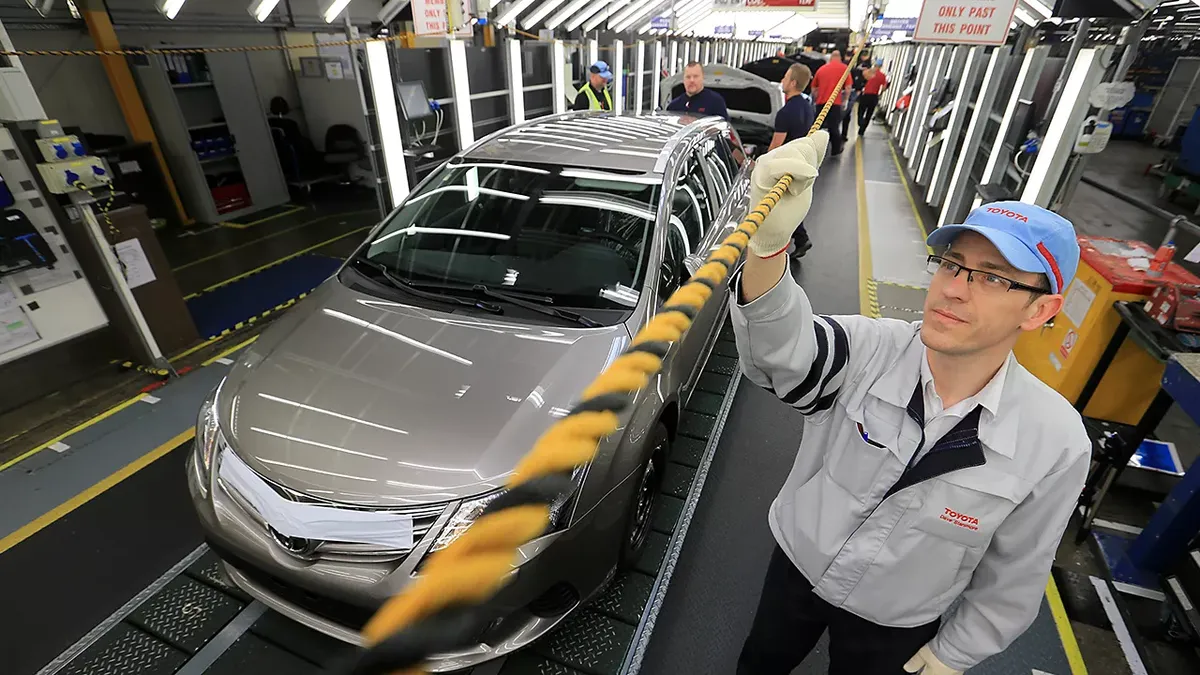
Post-World War II, the Japanese manufacturing systems needed efficiency. Japan did not have the luxury of consistent, high-volume demand, nor did they have the space or cash for huge inventory systems. They needed flexibility, and they could not spare any waste. Taiichi Ohno, an industrial engineer with Toyota, accepted his new reality that he could not simply push supply through mass production methods. Toyota needed to listen to demand and have a flexible manufacturing paradigm that could quickly respond to actual sales.
Over time, Toyota's processes emphasizing flexibility and quality drove the company toward a set of labor-empowering practices. If any production issues were spotted on the line, an employee could stop the entire line and have neighbors surge on the problem. If employees need to help out their fellows in the event of an issue, it helps to have them cross-trained. If you've got employees cross-trained on all your company-specific manufacturing stations, the cost of that employee ever leaving is extremely high. You can't just hot-swap a new person in there.
Computer-aided design hits the market properly in the 1980s. The cost of imagining new products drops to extreme lows. You don't need human drafters painstakingly drawing new parts. Just have the machine do all your calculations for you. This kind of customization was a nightmare for mass production shops. But Japan, with its existing practices of low inventory stockpiles, highly flexible and highly cross-trained employees, and general focus on low costs, just rolled with it. They were already set up for the new tech before it even hit.
Returns were continually re-invested back into the business, and foreign capital was considered highly undesirable. Boards of directors were generally comprised of managers from within the company. Dividends were limited. This isn't a system that drives cash back into the hands of investors. It is practically employee-owned.
The Boston Manufacturing Company

Let's look at the opposite end of the spectrum: a very top-down approach where the entire company structure is built around a particular labor-saving technology.
In the early 19th century, American merchant Francis Cabot Lowell traveled to England to study the textile industry that had grown up around a critical new technology: the power loom. Instead of the traditional hand-weaving techniques, a power loom uses mechanical energy (such as a moving river) to drive the gears of the loom. An extremely powerful, well-trained, well-compensated engineer supervised multiple looms at a time. The rest of the labor force consisted of very low cost labor. (they employed children)
There was no worker empowerment, unless you were one of those experts who scaled themselves through automation. Those engineers were paid multiples of the standard weaver's rate, because their expertise and deep knowledge of the looms meant they were mission-critical to the profit system of the firm. (sound like an engineer running a team of agents? sounds like it to me)
Profits weren't re-invested back into the business beyond basic maintenance. Profits were taken by the shareholders. They had put their investment in to make all this infrastructure happen, and they took their returns out. If they stopped the machines, people didn't get paid. The system worked like this for years until it was superseded by a social shock in the form of the Civil War.
Complementarities
Complementary goods are goods that pair well together. Consider my snack choices. I enjoy apples and peanut butter together. I also enjoy oysters and vinegar together. If I have more apples, I'm going to want more peanut butter. If I have to choose between apples/peanut butter or oysters/vinegar, I'm going to choose oysters and vinegar every time.
But if I have peanut butter, and you give me oysters to add to it, this is just an actively worse pairing than either.
Additionally, consider the purchasing realities of each of these goods. I can purchase apples and oysters one at a time, but I have to buy vinegar by the bottle and peanut butter by the jar. If I need one jar of peanut butter for every twenty apples, and I want twenty-two apples, then I'll have a lot of extra peanut butter left over. Wasted peanut butter also may make me unhappy. (It doesn't, because I'll just eat it straight out of the jar, but work with me here.)
So, with some basic economics and math, we can express a notion that two things can be good together, maybe even actively good individually, and yet still be actively worse if you pair them up incorrectly. Which brings us back to the 1980s.
(there are mathematical expressions of complementarities toward the bottom, for the curious reader)
Milgrom and Roberts
Economists Paul Milgrom and John Roberts wrote a 1990 paper "The Economics of Modern Manufacturing" that explored this idea in the context of a manufacturing firm. The firm wishes to maximize profits. It has two manufacturing paradigms it can pursue:
- mass production (long runs, high inventory, rigid equipment, low variety, low worker autonomy)
- flexible production (short runs, just-in-time inventory, computer-aided design and flexible equipment, high variety, and highly skilled - and more expensive - workers)
They looked at those as choices as variables:
- r: length of production run
- i: size of inventory
- e: type of equipment
- v: level of variety
- w: caliber of worker and associated training
Milgrom and Roberts declared that the firm was a profit-maximizing function p(r, i, e, v, w, θ), where θ was a general variable representing the economic environment. Through a complex series of proofs that I won't rehash here, they demonstrated that companies are basically bundles of procedural choices like this. You can choose the mass production bundle, and it's internally coherent. You can choose the flexible production bundle, and it's also internally coherent. But there's not a good in-between. High inventory with high variety is the corporate equivalent of oysters and peanut butter. The choice actively sucks worse than if you'd just picked a bundle.
The andon cord
In the late 1990s, it took Ford 50% more hours to manufacture a car than Toyota, with a lower quality bar. Ford couldn't make a profit. Desperate for ideas, GM studied the famous Toyota Production System, which included a pullcord at every station that would stop the entire production line.
At the Toyota plant in Kentucky around this time, workers pulled that andon cord two thousand times per week. When Ford built a new plant, they installed the same cord. Workers pulled the cord twice a week. Twice. Versus two thousand. By the time Ford and GM got anywhere close to Toyota's level of productivity, they had cut their output by a third, cut their workforce by 80%, and steamrolled their relationship with parts suppliers.
The Japanese manufacturing system wasn't just about pulling a cord. Employees were cross-trained at neighboring stations, so that pulling a cord for help meant that your neighbor could run over and actually be of use in sorting out what went wrong. Toyota managers were focused on quality metrics, such that a small delay in the production line was viewed more favorably than allowing a problem to persist. Toyota higher-ups maintained strong relationships with suppliers, even when times were tough, because wanted suppliers similarly invested in a high-quality experience. None of this matched up with the American automobile manufacturing experience at the time.
The andon cord in the Ford production system was the peanut butter to their oysters.
Where AI plays in
Let's bring it all together.
We have the injection of a new technology, artificial intelligence, that promises to dramatically improve knowledge work. It offers the potential of greater speed, more flexibility, and perhaps higher quality in outputs compared to the traditional approaches.
When we look at this historical record for what happens when you inject a transformative technology like AI into traditional enterprises, one of two success patterns fall out.
In the Japanese lean manufacturing example, Japanese firms were already organized for flexible manufacturing when computer-aided design hit the market. Workers were already empowered to make changes to benefit the organization. When computer-aided design and other lean manufacturing tools came along, they were rolled right into the existing philosophy. Their corporate bundle already made sense with a worker-accelerating technology.
In the Boston Manufacturing Company example, Francis Cabot Lowell studied the power loom and the British textile industry that had grown around it. The first power loom in America wasn't built and integrated by an existing textile firm. They couldn't make it happen with their existing operations, and a completely new company was built around the power loom technology. From the beginning, the Boston Manufacturing Company bundle was structured around this technology.
The lesson from history here is clear. You can have an empowered labor force with high autonomy, and they can incorporate a labor-improvement technology themselves. Or you can build an entire company around the structure of a new technology. Other bundles do not work. A deeply hierarchical organization with disempowered workers does not figure out how to incorporate the andon cord and computer-aided design. You build a new organization from the ground up, or you change your culture.
Why it's just not working
Mass production paradigms and the Boston Manufacturing Company teach us that you can have top-down control, high automation, limited worker empowerment (save a few highly skilled, highly paid individuals), profit concentration, and repeatable experiences... and it will work. You have to plan the entire thing out from the top and you have to be very, very right in the correct market, but it will work. You have complementarities here.
Alternatively, you can have worker empowerment, distributed decision-making, continual re-investment, and employees will figure out how to use the tech, just as they did with computer-aided design in the 1980s in Japan. Those areas, too, are complementarities.
The in-between doesn't work. The substitutes don't work. They are not an effective bundle of corporate practices.
Say the Boston Manufacturing Company focused heavily on training highly skilled engineers to run the power looms, but they compensated them like the other workers doing basic tasks. Now they're poachable. Or say the Japanese system wanted to have a ton of profit-taking, and eventually there's a bad economic quarter. Now they've got to fire people to sustain the dividend, and all that latent knowledge is lost. The andon system no longer works as effectively when you don't have as many cross-trained individuals nearby the problem to sort it quickly.
American SaaS businesses are struggling with AI because they are not embracing one bundle of corporate practices or the other. They are caught in the middle. They want the returns of the top-down Boston Manufacturing System with the worker initiative of the Japanese system. They want CEOs who see themselves as visionaries while also thinking that their employees might drive new product development themselves, instead of the visionary CEO. They are asking for oysters and peanut butter and wondering why it tastes horrible.
Why it will work, in the end
Eventually, a set of businesses will emerge with a relationship to AI technology that looks a lot like the Japanese system. Palantir, with its Forward-Deployed Engineer paradigm that places tremendous power in the hands of individual customer-facing individuals, is a prime example of AI in the new world. NVIDIA's corporate code has echoes of the Toyota Production System, with its emphasis on "no waste," "extreme operating efficiency," "alertness and agility." In businesses that adopt this bundle of practices, power will be highly distributed throughout the firm and employees will have a disproportionate capability of shaping how they go to market.
There will also be a set of businesses that looks a lot like the old Boston Manufacturing paradigm, such as Anthropic today. They carry immense capital costs, which they budget from the top down. They have a set of workers focused on AI research that drive a disproportionate share of salary costs. At the moment, Anthropic controls the foundation model market, and they can push new models like Henry Ford used to push Model T's. Will it last forever? Only as long as they stay the best.
Both systems work. You just have to pick your bundle of practices, and stick to it. The market will settle, and the victors will look like one of those two paradigms.
The past
I'm rarely concerned about how things shake out in the end, because we humans have a long history ourselves of just figuring it out.
Consider Samuel Pepys, the Enlightenment-era Royal Society Fellow who kept meticulous notes of his personal and professional dealings and gave us an excellent window into the life of a seventeenth-century upper-class gentleman. On January 31st, 1663, Pepys writes:
...I did make up my monthly accounts, and find that I have gained above £50 this month clear, and so am worth £858 clear, which is the greatest sum I ever yet was master of...
The following day, Pepys writes that he takes a cab into town to go spend time with the King and later see a play, all without materially affecting his £858 in personal wealth.
Pepys remarks throughout his diaries about the pressures of inflation, and so while I suspect that he would find it remarkable that individuals are paid £858 per week to kick a ball around at the lowest tier of professional football, he'd be able to process it. I believe he would find it significantly harder to fathom that the pound sterling no longer has any relationship to the price of the metals. And I doubt he would believe at all that Ireland, Germany, France, Italy, and Spain had all agreed on a single currency while each maintaining their separate governments.
All of these advances, all of these changes in economic practice, all of these technological changes... we change through them, but we end up making it through another round. Inevitably, we forget it again, and I get to write another blog post.
Appendix: the math on complementarities
Mathematically, you can express a complementarity as a choice space {0,1} * {0,1}, where each dimension represents a pairing:
- x1 = oysters (0 = no, 1 = yes)
- x2 = vinegar (0 = no, 1 = yes)
- x3 = apples (0 = no, 1 = yes)
- x4 = peanut butter (0 = no, 1 = yes)
In this structure, (1,1,0,0) is the oysters/vinegar pairing and (0,0,1,1) is the apples/peanut butter pairing. (1,0,0,1) is the dreaded undesirable oysters and peanut butter pairing.
A supermodular function is one that displays complementarities among its arguments.
Consider a function f(x1, x2, x3, x4) = 3x1x2 + 3x3x4 - 2x1x4 - 2x2x3. The first term x1x2 represents the oysters/vinegar pair. The second term x3x4 represents the apples/peanut butter pair. There's a benefit (the 3) attached to the two positive pairs, and a penalty attached to the off pairings. We can see the complementarities appearing in the arguments here.
Topkis's theorem states that if a function is supermodular, then the optimal choice increases along with the parameters. Complementary inputs move together, either positively or negatively. If I have more apples, I'm going to want more peanut butter. Optimal decisions cluster.
Milgrom and Roberts backed into this with a set of assumptions about the profit function for firms. If you have superior technology, and you need skilled labor to operate that technology, you're not going to keep employing unskilled labor. That wouldn't maximize profit because you've just got dead weight sitting around. You'll either hire skilled labor directly, or unskilled labor with training. Superior technology and skilled labor are complementarities.
Therefore, you do more of the complementary practices together. You have bundles of corporate practices. You may want to be in a better corner of the hypercube with higher profit, but to do that, you've got to move through an intermediate space with lower profit. And if firms don't have the stomach to do that, they can't make the transformation.
Special thanks to David Oks for the original inspiration about Japanese firms and optimal corporate structures, which led me to the Milgrom and Roberts paper.